How Amateur Theatre Societies Shaped Their Own Traditions
Amateur theatre history reveals how local societies shaped their own traditions through shared choices about plays, roles, rehearsal and community events.
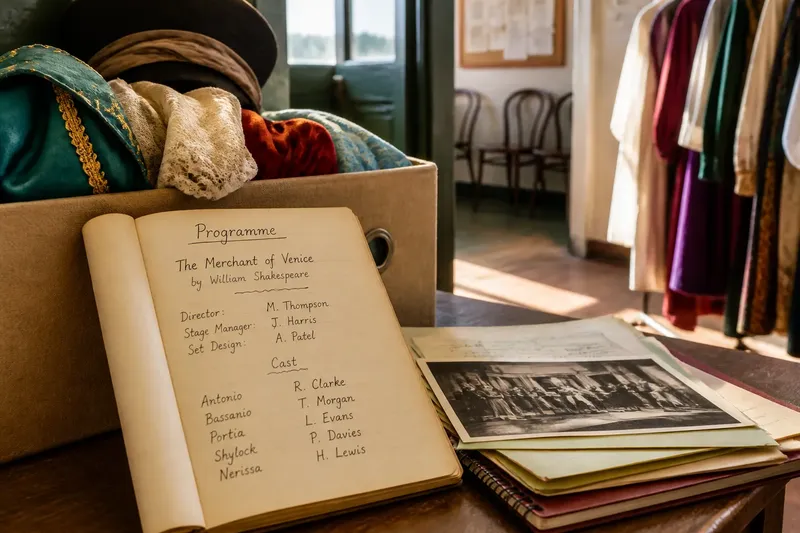
A handwritten programme sits beside a box of borrowed costumes while a cast waits for the caretaker to unlock the hall. Amateur theatre history is often preserved in such local traces: the records of groups that made performances together and developed working habits suited to their members and circumstances.
Local records show how each society worked
There is no single timeline or rulebook that describes every amateur theatre society. A group’s surviving programmes, minutes, newsletters and photographs can show what it chose to perform, who took part and how it organised its work. Those records are a firmer starting point than a broad claim that societies all changed in the same way.
Look for recurring details rather than assuming a universal pattern. A programme might name a director and cast but leave backstage contributions unlisted. Meeting notes may record how roles were allocated or how a production was selected. A photograph can show the layout of a particular performance, though it cannot explain every decision behind it.
When records are incomplete, distinguish what they show from what remains uncertain. Memories from former members can add context, but they are personal accounts; compare them with dated documents where possible. That careful approach makes a local history more specific, not less interesting.
Societies built routines around their own needs
A theatre society could provide a regular way for people to read plays, rehearse and organise performances. Its habits depended on its members, available space and local connections. Some groups might meet through an existing club or institution, while others might organise independently; neither arrangement defines amateur theatre as a whole.
Over time, a particular group could settle into familiar practices. It might choose plays by discussion, hold open auditions, ask returning members to lead rehearsals or stage an event associated with its community calendar. These are possible local customs, not rules shared by every society.
That distinction matters. A group’s traditions can shape who feels welcome and how work gets done, but they can also change when membership or circumstances change. To describe a society’s development, follow the evidence in its own records rather than presenting a general overview as a universal history.
Shared decisions gave productions a local character
A script offers dialogue and a sequence of events; a production team decides how to make them work in its setting. Members may agree on a playing area, choose simple props, plan entrances or decide how the audience will be seated. These choices can reflect the resources at hand without implying that every group worked in the same way.
Think of a society’s customs like a well-used recipe card: it helps people remember how this group likes to work, but another group may have a different card. The analogy also has limits. Theatre traditions are not fixed instructions; members can revise them as their aims and circumstances shift.
Imagine a community group with a small hall, a script requiring several quick entrances and no separate backstage room. Members decide to use a side doorway, mark a waiting area with chairs and assign one person to cue each entrance. The expected observable result is a clear route on and off stage, while the cast can judge whether the arrangement suits the room before settling on it.
How can you trace a society’s own history?
What sources can reveal an amateur theatre group’s past?
Try programmes, meeting minutes, club newsletters, photographs and local archive catalogues. Record dates and names as they appear, and mark gaps rather than filling them with assumptions.
How can you tell whether a custom was unique to one society?
Check whether the custom appears repeatedly in that group’s records, then compare it with accounts from other local societies if available. Without that comparison, describe it as a practice of the group rather than a general rule.
How should you use memories from former members?
Ask what the person remembers and when they took part, then keep their recollection distinct from documentary evidence. If a programme or minute book offers a different detail, note the difference rather than silently choosing one version.
What can an old programme tell you?
It may identify a play, cast, venue or named production roles. It cannot necessarily show how decisions were made or who contributed without being credited, so treat it as one piece of evidence.
Check the evidence before describing a local tradition
- Check the date printed on a programme; if it is clear, use it for that event, but if it is missing or damaged, describe the date as uncertain.
- Check whether meeting minutes name a play-selection process; if they do, attribute that process to the recorded meeting, but if they do not, avoid claiming how the group chose plays.
- Check whether a photograph has a caption or identifiable venue; if either supports the location, state that cautiously, but if neither does, do not assign it to a particular hall.
- Check whether a former member’s recollection matches a surviving document; if they agree, present both as supporting accounts, but if they differ, report the discrepancy and retain the uncertainty.
- Check whether a named backstage role appears across several records; if it recurs, describe it as a documented feature of that society, but if it appears once, describe only that production.
- Check whether another society’s records show the same custom; if they do, say the practice appears in both groups, but if no comparison is available, keep the claim local.
Amateur theatre history is strongest when it stays specific
When you explore amateur theatre history, look beyond the play title and cast list. Ask what the records reveal about the people who organised the event, the space they used and the choices they made. A careful account can show how one society developed its own habits without suggesting that every community followed the same path.
For a present-day group, keeping programmes and brief production notes can make those choices easier to trace later. Record what happened, who contributed and what remains uncertain. The next person looking back will have a clearer picture of how that particular society made theatre its own.