A Five-Minute Scene for a Long Afternoon Indoors
Make a five-minute scene indoors with a playable map, clear stage pictures and a satisfying ending, using ordinary objects and a small cast.
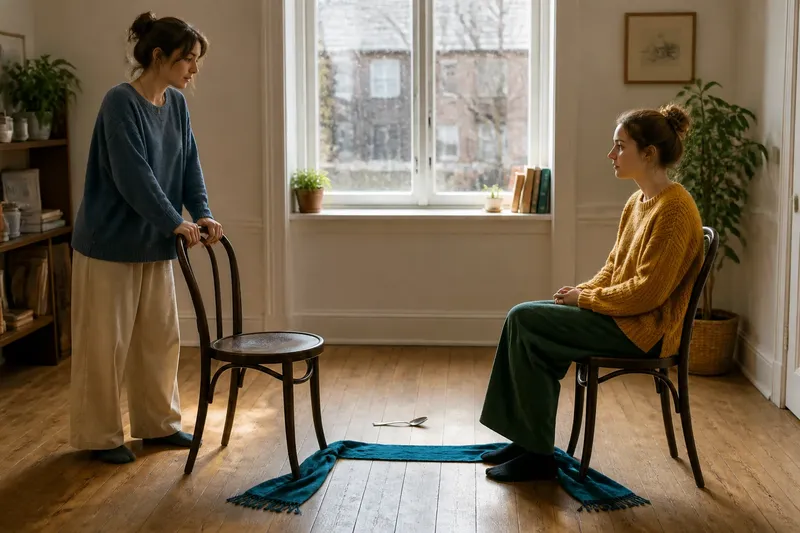
A teaspoon sits between two kitchen chairs while rain taps the window. To make a five-minute scene indoors, give an ordinary object a theatrical job: let it mark a boundary, signal a change of place or become the centre of a tiny ceremony.
That approach gives the scene a visual design, not just a problem for two characters to solve. The performers can build a sequence of stage pictures, each with a distinct arrangement of bodies and objects. The result can stay playful and small, with no finished script or elaborate set.
Make the object part of the stage picture
Choose an object that is safe to handle and easy to see: a scarf, mug, pencil or teaspoon. Decide what it does onstage before deciding what it means. A scarf might become a river, a curtain or a line that nobody may cross. The object works like a patch of coloured paper in a collage: its position helps the audience read the whole picture.
Set two chairs at an angle, leaving a clear patch of floor between them. Place the teaspoon there. One performer stands outside the chairs; the other sits with their hands folded. Hold the picture for a breath before anyone speaks. The audience gets a chance to notice the space, the object and the difference between the performers’ positions.
Now give each person a physical task rather than a plot problem. One may try to cross the space without stepping near the spoon; the other may arrange the chairs to keep the gap open. Repeat the movement with a new quality—careful, grand, sneaky or ceremonious. The change in style can make the same simple action feel like a fresh theatrical event.
Build a sequence of changing stage pictures
Think of the scene as a short gallery of pictures connected by movement. Each picture should alter a visible element: distance, height, direction, focus or the object’s place. A performer standing on one side of the room and another crouched by a chair creates a different composition from two people facing each other across the teaspoon.
Try this simple structure:
- Opening image: Show the object and establish how the performers relate to it.
- Variation: Change one physical element, such as who is nearer or who is looking away.
- Transformation: Let the object or the space take on a new stage function.
- Final image: End in a clear arrangement that feels different from the opening.
Keep transitions visible. A slow turn, a shared lift of the chairs or a deliberate handover can connect two pictures without extra dialogue. If a transition looks muddled, pause in the new arrangement and work backwards: decide where each performer starts, what they move and where they finish.
Give each picture a different theatrical quality
Rather than adding a new conflict, change the style of the playing. The same arrangement might become a formal portrait, a silent film, a weather report or a royal procession. These are invitations to physical invention, not demands for elaborate costumes or accents.
For instance, the performers can treat the teaspoon as a microphone. One delivers an imaginary announcement while the other silently rearranges the chairs into a tiny audience. Then they can replay the picture as a solemn ceremony, with the spoon passed from hand to hand. The shift in rhythm and gesture gives the scene contrast without piling on plot.
Sound can help, too. Use a repeated footstep, a quiet hum or a clap to mark when the picture changes. Keep any sound easy to repeat and safe for the room; a phone speaker is optional, not necessary. The performers should be able to return to silence and still make the image readable.
Say you have two chairs and a scarf; how could the scene unfold?
How do you make an object suggest a place?
Give it a consistent physical function: lay the scarf across the floor as a river, then show how each performer approaches or crosses it. The audience can follow the imagined place because the object’s position remains clear.
How much dialogue should a short scene use?
Start with no dialogue, then add only lines that clarify a change or create a useful rhythm. If the stage pictures already tell the story, silence may be the stronger choice.
How can two performers create variety?
Change levels, distance, direction and timing, and let each performer take a different focus. A seated figure watching a moving partner can make a sharper picture than two people doing the same action.
What if the ending feels unfinished?
Return to the opening arrangement and alter one visible detail, such as who holds the object or which way the chairs face. Hold the final image briefly so the audience can register the change.
Work through a complete invented scene
Imagine Mina and Jo have two chairs, a scarf and a bare patch of floor. Their starting picture has Mina standing behind one chair while Jo sits opposite, with the scarf stretched between the chairs. They agree that the scarf is a river, but leave its meaning open.
First, Mina walks along the riverbank while Jo watches from the chair. Next, Jo rises and turns both chairs to face the audience; the scarf now reads as a stage border. Mina steps over it and bows, while Jo responds with an exaggerated, silent round of applause. For the final picture, they move the chairs side by side and lay the scarf across their laps like a shared ribbon. They sit facing front, holding still.
The resulting scene has three distinct images: a river, a performance and a quiet shared tableau. The trade-off is deliberate: it offers less spoken explanation, so performers need precise movement and clear pauses. If an audience cannot read a transformation, the pair can sharpen the object’s placement or make the change of style more pronounced.
Keep the scene playable in a small room
Before repeating the scene, check the room and objects for practical snags. A narrow space may suit seated movement better than crossing; a slippery scarf should stay in the hands or on a chair rather than underfoot. Make each choice according to what the room actually allows.
- Check whether the object is easy to see; if it disappears against the floor, move it onto a chair or choose a clearer object.
- Check the walking route between chairs; if it feels cramped, keep the action in place and change levels or focus instead.
- Check whether the chairs stay steady; if they wobble, leave them still and move the performers around them.
- Check whether each transition has a clear start and finish; if either is hard to follow, simplify the movement or hold the picture longer.
- Check whether the sound can be repeated comfortably; if it becomes tiring or too loud, replace it with a hand gesture or silence.
- Check whether the final image differs visibly from the opening; if it does not, change the object’s position, the performers’ levels or their direction.
Once the sequence reads clearly, jot down the order of the pictures and any essential object movements. Leave the exact gestures and timing flexible. A five-minute scene indoors can then be repeated without becoming stiff, while still giving its performers a clear visual shape to play.